

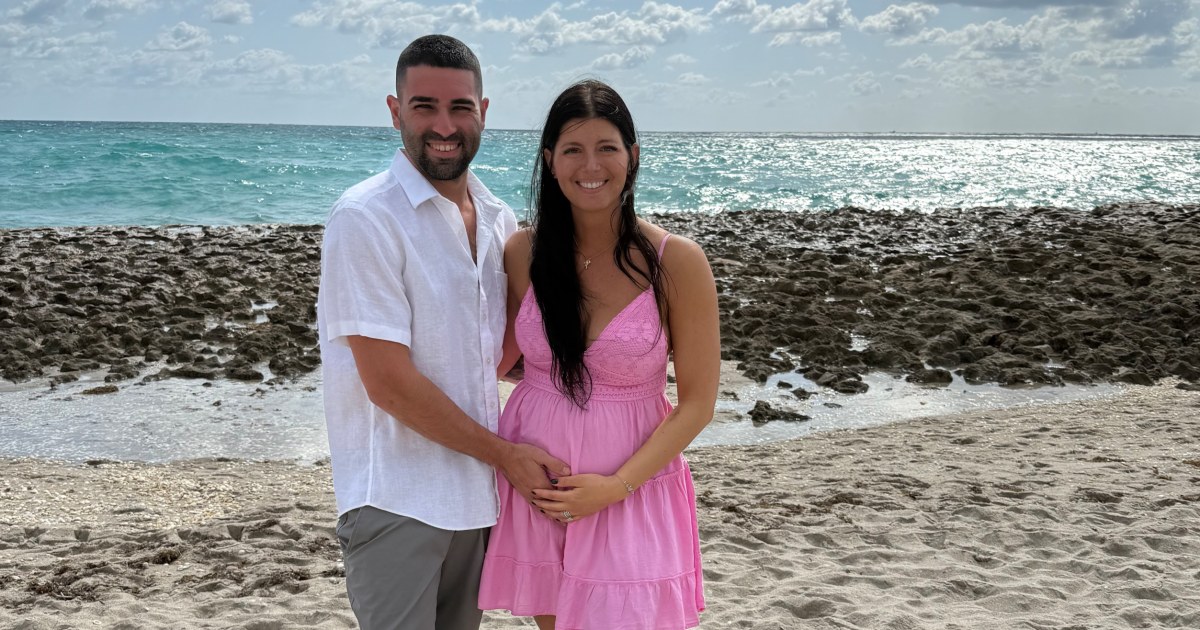
When 32-year-old Christina S. found out she was pregnant with her second child, she and her husband, Jeremy, were elated. The couple had been trying for months to get pregnant after suffering a miscarriage.
“It was a very, very happy time,” Christina tells TODAY.com.
However, everything changed about a week later when she made a chance discovery while taking a shower — one that saved her life, she says.
Christina, a former teacher from Yonkers, New York, was only about four or five weeks along at the time. “Back in January, after I found out I was pregnant, I was doing a breast self-exam in the shower, which is something I always kind of did,” says Christina.
A self-exam involves feeling the breasts for any new or unusual changes, such as lumps, which you can perform at home, per the Cleveland Clinic.
As a healthy, young person with no known risk factors for breast cancer, the self-exam was something Christina did out of habit during showers, sometimes without even realizing.
“This time, it was different. I felt a lump,” says Christina.

‘Weird’ Lump During Breast Self-Exam
At the ultrasound appointment to confirm her pregnancy, she mentioned the lump to her obstetrician. “I told him I’d never felt the lump before and something feels weird about it,” she says.
Christina then got a mammogram, which confirmed a suspicious mass on her right breast. A biopsy revealed the lump was cancerous. In February, she was diagnosed with Stage 2 invasive ductal carcinoma, the most common type of breast cancer, per the American Cancer Society.
“It all happened in a two-week span, it was so fast. … I found out I was pregnant, I was so happy, then it all spiraled downhill,” says Christina.
The diagnosis came as a shock. “I had no family history. I did all the genetic testing, too. Everything came back negative,” says Christina, referring to tests for inherited gene mutations that can increase cancer risk (such as BRCA1 or BRCA2), per the ACS.
Even more surprising, she was only 32. Most breast cancers occur among older adults, and the risk increases significantly after 50. “Mammograms aren’t even recommended until you’re 40, so that wasn’t even on my radar,” says Christina.
Christina is one of many young breast cancer patients blindsided by their diagnoses. “Feeling something different (during the self-exam) saved my life. No one else would have found it,” she says.
Breast Cancer Diagnosis While Pregnant
Breast cancer occurs in 1 out of every 3,000 pregnancies, according to the National Cancer Institute.
Christina was only six weeks pregnant at the time of her diagnosis. “It was so early in my pregnancy. Now, adding this huge layer to the most delicate 12 weeks was heart-wrenching and scary,” she adds.
She was determined to fight the cancer while pregnant. “I’m a very type A person. … I’m like, no, I’ll do it, I’ll do it,” says Christina.
Due to the risks to the developing fetus, Christina was told she was unable to start cancer treatment during the first trimester. “A lot of institutions won’t take on a pregnant breast cancer patient,” says Christina.
Eventually, Christina was referred to NYU Langone Health, where her case was taken on by a team of two oncologists and a maternal-fetal-medicine OB-GYN. They helped her get through the first trimester, while quickly developing a treatment plan.
“We like to wait until the second trimester because the pregnancy is more developed and less of a risk,” Dr. Mary Gemignani, Christina’s oncologist and a breast surgeon at NYU Langone Perlmutter Cancer Center, tells TODAY.com.

Breast cancer treatment during pregnancy is possible, but usually requires some changes to protect the fetus. “Sometimes the treatments differ if someone is pregnant, and we knew this was going to be a high-risk pregnancy,” says Gemignani.
After many tests and consultations, Christina was able to proceed with treatment during her second trimester.
Mastectomy and Chemo During Pregnancy
Christina opted to get a mastectomy first, followed by chemotherapy. “Honestly, I just wanted it out. I wanted the cancer out if surgery was safe,” she says.
The pregnancy was far along enough for doctors to closely monitor the fetal heart rate, but not so late that pre-term labor was a concern, says Gemignani. “The timing worked very well,” she adds.
Christina had a unilateral mastectomy of her right breast, along with several lymph nodes removed, complete with a reconstruction.
The surgery was a success, and Christina took a month to recover before starting chemotherapy. At this point, she was about halfway through her pregnancy.
Chemotherapy, which uses drugs to kills cancer cells, can be safe during pregnancy. However, the type of treatment and timing may be affected, according to the ACS.
“We had to tailor her chemotherapy a bit,” Gemignani says.
Christina started with four rounds of AC (adriamycin-cytoxan) chemotherapy through an IV and PICC line. “It was very harsh … going through chemo while pregnant is not fun,” she says.
Christina opted to “cold-cap,” which involves protecting the scalp to reduce hair loss. “It was important to not lose my hair to try to keep some normalcy for my 4-year-old son.”
After the first phase of chemotherapy, Christina took another month off to recover — by then, she was in her third trimester. She then had eight rounds of abraxene before she had to stop.
“We had to time the delivery with the last doses of the chemotherapy,” says Gemignani.
Chemotherapy during pregnancy is not recommended within three weeks of delivery because it can lower the mother and baby’s red blood cell count, per the ACS. This can lead to a condition called neutropenia, which increases the risk of infection, says Gemignani.
Christina stopped chemotherapy four weeks before her planned due date, Oct. 4. She went into labor and delivered slightly early. On Sept. 26, she gave birth to a healthy baby girl, Isabella.
After giving birth, Christina enjoyed a month of rest at home with her newborn. Last week, she started another round of chemotherapy with a drug she couldn’t get while pregnant, as well as treatment with a monoclonal antibody therapy, which she’ll get once every three weeks for a year.
She is also planning to get another mastectomy to remove her right breast. “I’m just really determined,” says Christina.
“I think the prognosis is excellent. The surgery and response was great, we’re just completing the full primary treatment, but the expectation is that all of this is going to be successful,” says Gemignani.
Christina credits her support system, including her husband and family, as well as her medical team, for getting her through.
“Find your people, whether that’s family, friends, doctors. … You can’t do cancer by yourself, pregnant or not pregnant,” says Christina.

Be Aware of Changes in Your Body
Approximately 1 in 8 women in the United States will be diagnosed with breast cancer in their lifetime, with only 9% of new diagnoses in women under age 45, per the National Breast Cancer Foundation.
“Sometimes there’s this concept that a you’re too young for breast cancer, and that sometimes there’s more of a delay because no one expects it,” says Gemignani.
However, the rates of breast cancer among women under the age of 45 in the United States have been increasing slowly, according to the U.S. Centers for Disease Control and Prevention.
“A lot of these cancers that happen early in age don’t always have family histories, and they’re not always genetically driven, so physical examinations and being aware of your own body is very important,” Gemignani.
A new lump or mass in the breast is the most common symptom of breast cancer, per the ACS. Not all lumps are cancerous, but it’s impossible to tell by a self-exam, so it’s crucial to get it checked out by a doctor.
“I think the important thing is that Christina felt something, and she went directly to her doctor and advocated for herself,” says Gemignani.
According to the National Breast Cancer Foundation, other early symptoms of breast cancer include:
- Swelling or redness of the breast
- Changes skin texture
- Unexplained pain and tenderness
- Dimpling or puckering
- Nipple retraction
- Discharge from the nipple
Self-exams are an important early detection tool. However, the ACS and American College of Obstetricians and Gynecologists no longer recommends routine breast self-exams for average-risk women, due to the risk of false-positive results.
That said, many providers still recommend women do self-exams about once a month to get an awareness of their breasts and bring up anything unusual to a doctor.
“If there’s a change, get it checked out. I think that’s the important message,” says Gemignani.
link
More Stories
Beyond Morning Sickness: Hyperemesis Gravidarum
NEWS: ICE has been deporting pregnant and postpartum immigrants
How much exercise is safe during pregnancy? New research offers answers