




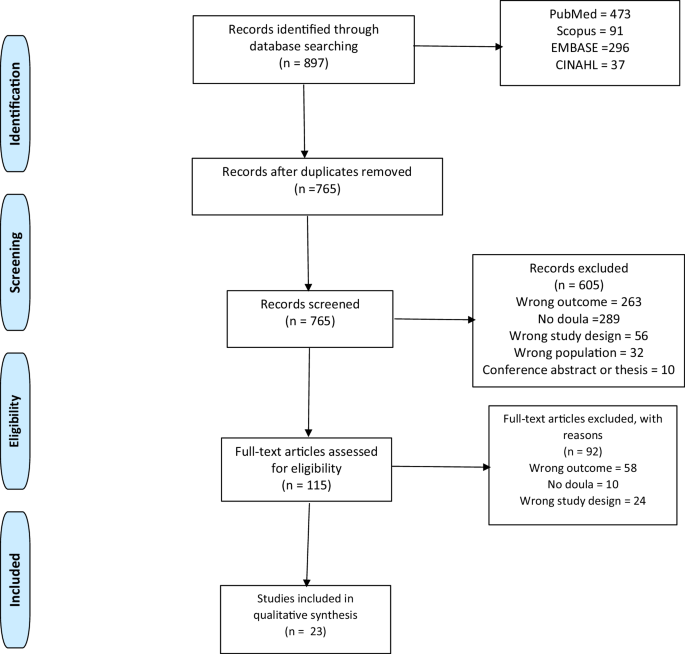
A total of 897 articles were found across six databases. A total of 130 duplicates were eliminated, resulting in a remaining count of 765 articles. Following the application of inclusion and exclusion criteria, a total of 115 articles remained after the initial screening process. In addition, when examining the complete text, 23 articles were chosen for the scoping review (Fig. 1).

From: Moher D, Liberati A, Tetzlaff J, Altman DG, The PRISMA Group (2009). Preferred Reporting Items for Systematic Reviews and Meta-Analyses: The PRISMA Statement. PLoS Med 6(6): e1000097. doi:10.1371/journal.pmed1000097. For more information, visit www.prisma-statement.org. The flow diagram of the review screening process shows the number (n) of studies that were originally identified, screened, and assessed for eligibility, as well as the reasons for exclusions.
Characteristics of included studies
This scoping review incorporated studies from various countries. Among the included studies, 13 studies were from the United States, consisting of 6 with a retrospective cohort design, 3 used a qualitative study design, 2 employed a mixed methods study, 1 used a randomized controlled trial (RCT), and 1 with a non-experimental study design. There were 2 studies conducted in Brazil (1 mixed methods study; 1 cross-sectional study), 1 in the United Kingdom (a qualitative study), and 1 each in Canada (RCT), Mexico (retrospective cohort design), Iran (qualitative study), and Australia (mixed methods study). Further, several incorporated racially and ethnically diverse samples. For instance, multiple U.S.-based studies1,5,23,25,26,27 focused on Medicaid recipients, Black and Latina women, or women from socioeconomically disadvantaged backgrounds. Some studies also centered on incarcerated women24,28 or adolescent births29, representing vulnerable and diverse populations. The studies focused on doulas’ roles in pregnancy care continuum before pregnancy, during, and post-partum. A total of 2 studies focused on before pregnancy, 10 studies focused on during pregnancy, 1 study on post-partum, and 10 studies were a mix of both during pregnancy and post-partum. The sample participants in the scoping review ranged from 13 to 279,008 (Table 1).
Doulas-impact on mode of delivery
A total of 13 studies investigated the effect of doulas on the mode of delivery and they yielded mixed results, ranging from nine positive16,25,26,29,30,31,32,33,34 to one neutral8 to three with negative impacts22,24,35. Most studies indicated a decreased occurrence of cesarean births, thereby increasing the chances of vaginal delivery and having positive labor outcomes for both the mother and the baby16,25,26,29,30,31,32,34. This body of research highlights not only a decrease in the rate of cesarean deliveries but also an increased prevalence of non-instrumental vaginal births25,26,29,31,32,33,34. Further, a mixed-method study suggested that doulas may also empower clients and normalize the delivery process, potentially contributing to positive outcomes in promoting vaginal deliveries30. However, one study showed no significant differences in cesarean delivery rates8.
Three studies indicated a negative impact of doulas on the mode of delivery, suggesting a higher level of cesarean deliveries in their care. For example, in a study by Hodgon et al. (2017), the care group was associated with a lower rate of spontaneous vaginal delivery (61% vs 72%) and higher rates of a caesarian section (25% vs 20%) when compared to the comparison group22. Similarly, another study indicated that the doula-supported group had a higher rate of cesarean delivery compared to the standard-of-care group (27.6% vs 14.6%)24. Furthermore, Byskog et al. (2020) suggested an increased adjusted odds ratio (aOR 1.43) of cesarean delivery for specific groups of immigrants women35.
Doula-based delivery support
Several studies shed light on the role of doula support in maternal care, focusing on labor induction, pain management, and hospital stays.
Labor induction
Five studies focused on labor induction, where four studies had a positive impact23,33,34,35, and one study had a mixed impact29. The study by Kozimannil (2013b) revealed that women with doula support were more inclined to use nonmedical techniques for labor induction, with a significantly higher odds ratio (aOR 3.03)23. Additionally, Nommsen-Rivers et al. (2009) found that women under doula care often experienced shorter second stages of labor, indicating a possible efficiency in labor progression with doula support33. Moreover, research by Byrskog et al. (2020) in Sweden suggested a positive relationship between doula support and natural labor induction. In this study, community-based doula (CBD) support was defined as culturally and linguistically concordant care provided by trained lay birth workers from the same community, with a specific focus on supporting migrant women during labor and birth. For migrant nulliparous women, community-based doula support was associated with an increased odds ratio (aOR 1.38) of natural labor induction, potentially indicating doulas’ support in managing the challenges of induced labor35. A study by Trueba et al. (2000) observed a markedly lower usage of Pitocin (oxytocin) in the doula-supported group (42%) compared to the standard care group (96%). The study also suggests that the doula-supported group had a lower mean labor length than its counterpart (14 h 51 min vs 19 h 38 min)34. Also, Everson et al. (2018) reported ~43% of women gave birth without pharmacological induction or augmentation assistance, indicating a possible role for doulas in reducing reliance on medical induction procedures. On the other hand, the same study reported that a significant proportion of women (30%) relied on pharmacological methods (e.g., prostaglandins, synthetic oxytocin, misoprostol) to initiate labor, with 35% requiring augmentation via synthetic oxytocin29.
Pain management
Six studies focused on doula support of pain management using natural and pharmacological interventions during labor. Four studies had a positive impact23,31,32,34 one mixed impact35 and one negative impact29. Research by Fernandes et al. (2019) found that doula support was associated with increased use of non-pharmacological pain relief methods (OR 9.68)31. Furthermore, Hans et al. (2018) suggested that those in the doula-led intervention group groups were less likely to utilize pain medication during labor (OR 0.47)32. Also, Kozhimannil et al. (2013b) found over 70% of women used nonmedical pain management23. Additionally, another study indicated that a doula-supported group received fewer epidurals compared to the control group (8% vs 32%) (Trueba et al., 2000)34. Similarly, Byrskog et al. (2020) study found that community-based doula support was linked to reduced use of pain relief methods for nulliparous women, especially in cases of epidural and bath usage (aOR 0.64, respectively). However, parous women with doula support had increased odds of labor induction (aOR 1.38)35. Further, according to the study by Everson et al. (2018), in the doula support program, approximately 50% of pregnant women received intravenous pain medications (epidural anesthesia) compared to the national average29.
Hospital stays
Only one study reported on the impact of doulas on hospital stays after childbirth. Byrskog et al. (2020) associated community-based doula support with longer hospital stays ( > 48 h) for parous women and longer post-birth hospital stays (OR 1.19) for nulliparous women35.
Doulas’ support on child outcomes
The data from various studies provide insights into several key child outcomes which include gestational period, birth weight, child mortality and morbidity, and breastfeeding initiation.
Gestational period. Five studies have shown a reduced rate of preterm birth with doula support. For several studies, approximately 5% of women gave birth before completing 37 weeks of gestation8,22,24,29. The study conducted by Kozhimannil et al. (2013a) emphasized a reduced incidence of preterm delivery, approximately 6.1%, among births who received doula support in comparison to national Medicaid participants25. Additionally, the Everson et al. (2018) study reported that 92% of neonates were full-term at birth and 3.1% were post-term in the doula support program ( > 42 weeks of gestation) compared to the national average29.
Birth weight
Four studies focused on birth weight, including three studies that had a positive effect1,8,29 and one study had a mixed impact24. According to Everson’s (2018) research, the utilization of doulas was found to be associated with a low birth weight (LBW) ( < 2500 g/<5.5pounds) rate of merely 10% among newborns, whereas approximately 7% of neonates were classified as macrocosmic ( > 4000 g;>8.8 pounds)29. Another study conducted by Gruber et al. (2013) indicated that moms who did not receive assistance from a doula were four times more prone to give birth to LBW infants, accompanied by fewer difficulties, compared to mothers who were aided by a doula1. Further, a study by Thomas et al. (2017) suggested being enrolled in the doulas-based intervention led to a lower percentage of LBW (6.5%) vs the comparison group (11.1%)8. However, one study found no significant differences in LBW between the infants born to women in prison having doula support (3.9%) when compared with the control group (5.7%)24.
Child morbidity and mortality
Out of two studies that focused on child morbidity, one also discussed the issue of mortality. Everson et al. (2018) suggested that in a national sample of doula-supported adolescent births, ~9% of the infants experienced adverse health concerns immediately after birth, and 5.6% were admitted to the neonatal intensive care unit (NICU). This study also reported a total of 10 stillbirths, resulting in a fetal fatality rate of 5.27 per 1000 births29. Another study by Shlafer et al. (2021), examined the health outcomes of infants born to incarcerated women and suggested that women who received doula services found that infants had a median APGAR (Appearance, Pulse, Grimace, Activity, and Respiration) score of 9, with approximately 6% of instances resulting in NICU hospitalization compared to a comparison group and suggested no significance differences24.
Breastfeeding initiation
Eight studies discussed breastfeeding initiation with five studies highlighting the positive impact1,28,32,33,36 and three studies with a negative impact22,30,32 of doula support on breastfeeding initiation. The Gruber et al. (2013) study, which included a sample of 248 women, suggested that approximately 90% of adult participants who received doulas support initiated breastfeeding1, compared to a lower rate in the control group. Another study by Hans et al. (2018) indicated that mothers in the doula’s intervention group were more likely to initiate breastfeeding while in the hospital (OR 1.67), but breastfeeding was not sustained over time32. Similarly, another study suggested that doula care was associated with an earlier onset of lactogenesis within 72 h of postpartum and the infant sucked well on day 3. Doula care was also associated with a high prevalence of breastfeeding at six weeks when compared with its counterpart (89% vs 40%)33. However, in a study by Hodgson et al. 2017, no significant differences were observed between the doula’s group (84%) and the control group (78%)22.
A mixed-method study conducted by Diezel et al. (2013) indicated pregnant women valued the care provided by student doulas about breastfeeding in five domains, namely physical, emotional, support person, and usefulness30. Furthermore, another mixed-method study by Shlafer et al. (2018) identified that 69% of study participants discussed breastfeeding at least one time with their doula. Women who discussed breastfeeding with their doulas were seven times more likely to initiate breastfeeding than women who did not. The qualitative inquiry identified three overarching themes from the doulas’ narratives about breastfeeding initiation among incarcerated women: breastfeeding benefits for the mother-child relationship, real or perceived barriers to breastfeeding, and the role of the doula in supporting mothers’ breastfeeding initiation28. Moreover, a qualitative study (Ganon et al., 2022) suggested that the involvement of doulas in the perinatal period would help breastfeeding initiation36.
Doulas as maternal mental and well-being support
The assistance provided by doulas and the benefits they offer women during pregnancy and childbirth has been associated with a favorable impact on women’s mental health and maternal and child support.
Mental health
Only one study Falconi et al. (2022), found women who received doula care during pregnancy had 57.5% lower odds of postpartum depression/anxiety (OR 0.42)16.
Maternal and child support. Nine studies discussed maternal and child support which included nine with a positive impact8,27,30,32,37,38,39 and two with a mixed impact30,36.
An RCT study by Hans et al. (2018) suggested that doula-supported mothers were observed to be more likely to attend childbirth preparation classes (50% vs 10%) and more likely to utilize car seats at three weeks postpartum (97% vs 93%). Qualitative studies highlighted the critical function of doulas in caring for pregnant mothers32. Studies by Diezel et al. (2013), McGarry (2016), McLeish (2019), and Safarzadeh (2018), collectively highlighted the beneficial role of doulas in providing valuable information, fostering trust, empowerment, and enhancing self-esteem among pregnant women. These findings indicated that doula support positively influenced maternal confidence, decision-making abilities, and mental well-being30,37,38,39. Further, Kozhimannil et al. (2016) found that doulas positively influenced pregnant women’s access to healthcare services and improved the quality of care received during pregnancy and childbirth, highlighting the importance of doula support in addressing health literacy and social support needs27. Similarly, Thomas et al. (2017) demonstrated the positive impact of the By My Side Birth Support Program on women from low socioeconomic communities, with high rates of infant mortality. The program, which provided doula support, received high satisfaction rates from participants, with nearly all women expressing willingness to recommend the program or use it again in future pregnancies8.
While Gannon’s study (2022) emphasized the positive role of doulas in minimizing stigma and providing support for pregnant women with opioid use disorder, it did not explicitly address any potential challenges or limitations associated with doula support in this context36. Diezel et al. (2013) highlighted the varied abilities and positive aspects of doula support, including their contributions to interprofessional teamwork and support for vaginal deliveries. However, this study did not delve into any negative aspects or limitations of doula involvement in maternity care30.
link
More Stories
Beyond Morning Sickness: Hyperemesis Gravidarum
NEWS: ICE has been deporting pregnant and postpartum immigrants
How much exercise is safe during pregnancy? New research offers answers