



Joint Pain; Orthopedics
From joint pain to cracking knuckles, Dr. Paulvalery Roulette addresses what the public really wants to know.

Page Leggett
Contributing Writer
You have to be confident in your expertise to host an online forum and open it with, “Ask me anything.”
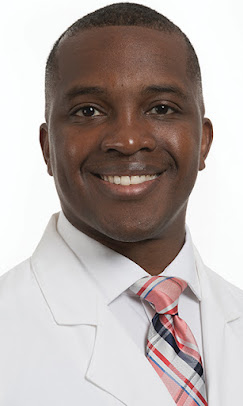
Dr. Paulvalery Roulette, an orthopedic surgeon at Novant Health Orthopedics & Sports Medicine – Matthews was ready for whatever the public lobbed at him during a recent event.
He’s a natural at relating to patients from all walks of life. That’s a result, he said, of his disparate life experiences. He’s a son of immigrants who’s spent a lot of time around other immigrant families. (He speaks fluent Haitian Creole.) And he earned his MD at one of the world’s most prestigious institutions: Harvard Medical School.
In his clinic, he treats children and adults who’ve had sports injuries, experienced trauma or have arthritis, nerve and blood vessel issues, soft tissue tumors and cysts. He loves playing sports, being part of international mission trips and mentoring young orthopedic surgeons, particularly those who are under-represented in the field.
Here’s what the general public wanted to know about orthopedics and what Roulette, a hand specialist, told them.
Orthopedic care that combines leading-edge technology with ease and convenience.
Learn more
As a younger female who tries to stay active, what are the best things I can do now to help prevent joint, bone or tendon issues later in life? Are there exercises, habits or even lifestyle choices you recommend to protect long-term orthopedic health?
I love to hear that you’re preparing now to have a healthy future. One of the most important things that women — and really, all of us — can do is participate in resistance exercises. That includes using free weights or resistance bands which help maintain bone density.
Resistance training helps strengthen your bones, which helps you now and as you age. A certified physical trainer and a certified nutritionist can help you avoid injury during resistance training and tailor a plan you can stick with. Resistance training also helps build muscle mass, which we all lose as we age.
There’s a great resource to get more information: The American Association of Orthopedic Surgeons has a site specifically for patients. At orthoinfo.org, you can look under the “Staying Healthy” tab for information on injury prevention, fitness and exercise and more.
Besides that, I highly recommend you work with your primary care doctor before starting any new exercise. I should add that it’s never too late to begin a fitness routine. If you’re in your 60s or 70s and haven’t done resistance training before, you can still do it. Just consult your primary care doctor first.
People always say cracking your knuckles will lead to arthritis. Is that true? And can you explain what’s happening inside the joint when knuckles are cracked?
I love this question. Often, my favorite questions as a doctor are the ones everybody wonders about but too few people ask.
There have actually been multiple studies that examined what happens when we crack our knuckles. Most of the research indicates that gas bubbles form when you separate two bones at a joint. The collapse of the bubbles creates that cracking sound.
Studies have looked at people who regularly crack their knuckles to see if they’re at higher risk of developing arthritis. But no study I’ve seen has shown a strong link between knuckle cracking and arthritis.
There’s no physiological reason that you shouldn’t crack your knuckles. You may not want to do it to be polite since some people may be bothered by the sound.
What supplements do you recommend to preserve bone density?
There are two things I recommend to help preserve bone health, and neither one has anything to do with supplements:
- Make sure you’re getting the right amount of calcium and vitamin D. Most Americans don’t eat a healthy diet. So, unless you know you do, ask your primary care provider if you need to add other sources of vitamin D to your diet.
- Take part in regular physical activity that promotes bone health. That includes resistance training. Again, if you’re new to resistance training, check orthoinfo.org — specifically the “Staying Healthy” tab — before getting started. And always consult your primary care provider before undertaking any fitness routine.
As for supplements, there are some that can be positive, but you should check with your primary care provider before taking any. Supplements aren’t regulated the same way medications are, and your doctor can help you understand side effects that can occur with certain supplements and any interactions that could occur with medications you’re already on. This is true especially for people who take blood thinners or any anti-seizure medication.
Anything you put in your body, your primary care provider should know about.
Women’s health is not as frequently studied as men’s. Do you see any common injuries that happen more often to women than men? And how can women prevent these?
In general, there are certain injuries that, due to anatomy, women are more likely to experience.
Women have a higher risk of ACL injuries than men do. ACL is the anterior cruciate ligament, and it’s at the center of the knee joint and connects the femur, or thigh bone, to the tibia, or shin bone. The quadriceps angle (what we call the Q angle ) — the angle between the upper and lower leg — is greater in women because they have wider pelvises. And a greater Q angle is associated with an increased risk of an ACL injury.
I’m in nursing school now and previously worked as an EMT and as an ortho tech in operating rooms, inpatient clinics and in private practice settings. Where do you think I could get the best ortho experience as a nurse?
What’s in a name?
During Dr. Paulvalery Roulette’s “ask-me-anything” forum, someone asked not about orthopedics, but about his name:
When your parents named you, did one want a boy and one want a girl?
“Though I would’ve loved that to be my origin story,” Roulette said, “I was named after a French poet with a strong interest in science who my mom admired. His first name was Paul, and his last name was Valéry.” Roulette’s family is Haitian, which is where the French influence comes in.
Valéry was nominated for the Nobel Prize in Literature a dozen times. His biographers believe he would’ve won it in 1945, had he not died that year.
While nearly everyone calls the surgeon “Paul,” there are two exceptions. A friend from church and Roulette’s high school vice principal use the full “Paulvalery.”
Congratulations on your decision to become an RN. It’s an amazing field.
You have the ability to be part of orthopedics in multiple ways, including managing outpatient clinics. You could also get even more involved in patient care if you were to go on to become a nurse practitioner.
The best place to get experience in orthopedics is in the operating room. There, you can work with multiple orthopedic specialties and learn the ins and outs of successful surgery. The second-best place would be the post-op area for orthopedic patients. That will help you get familiar with the post-operative needs of patients who have had surgery due to everything from trauma to elective cases.
For hypermobile hand and joint pain, what types of things can I do at home for pain management? I was considering compression gloves.
That’s a great question. Hypermobility is a very difficult disease process for patients because it can have multiple symptoms that can be hard to treat from a surgical perspective. Oftentimes, people with hypermobility syndrome get diagnosed late, because their symptoms can mimic other disease processes.
It’s helpful to work with a therapist who’s very familiar with hypermobility who can focus on helping you strengthen the muscles and tendons that go around joints to help them become better stabilizers.
Using a compression glove is reasonable if it makes you feel more secure in the joints when using it. There’s no specific brand that I recommend, but I do encourage you to experiment with different brands.
Lastly, don’t be afraid to ask for a physical therapist with a specific interest in hypermobility syndrome, because they tend to have great advice on different exercises or braces that have been beneficial to other patients.
Can a ‘neck hump’ be corrected? If so, what are some treatment options to consider?
“Neck hump” is a pretty generic term. There can be multiple causes that lead to more pronounced tissue on the back of the neck.
The most important thing to do is discuss this with your primary care physician and ensure you have an accurate diagnosis. Some neck humps can be treated, while others cannot. For example, if a patient has a neck hump from taking steroids, stopping the use of steroids can get rid of the neck hump.
A neck hump may be secondary to structural changes in your cervical spine, or it could represent a mass underneath the skin. Both of these may need to be addressed with surgery. All neck humps are not created the same, so it’s important to get a diagnosis.
link
More Stories
The Best Time To Drink Bone Broth for Collagen, Joint Health, and More
Why It Happens, How to Treat It
Why UK businesses lose productivity by misunderstanding bone and joint health – London Business News